

Did you know that by doing one specific thing you can solve the problem of the yellow leaves of mother-in-law’s tongue? Here’s what you need to do to reinvigorate this plant and make it thrive!
Does your mother-in-law’s tongue have yellow leaves and are you afraid it will die? Don’t worry, there is still a remedy and you can save the plant from a bad end. So let’s find out what you need to do to make mother-in-law’s tongue last a long time, which despite the curious name is a wonderful and decorative plant!
Sansevieria or mother-in-law’s tongue
Known as mother-in-law’s tongue, Sansevieria is a stupendous and decorative plant, which takes its curious name from the tall and sinuous leaves, which look like tongues . Ideal to keep in the apartment but also in other places, it resists high temperatures and cannot stand the cold .
To grow well it doesn’t need excessive maintenance, just a few small tricks that allow you to get great results. One thing that often occurs is the appearance of yellow leaves, let’s see how to prevent it and what to do.
Clean the yellow leaves
When the leaves turn yellow the main reason can be the attack by insects and pests . Another reason may be that they don’t absorb enough light , or they are just dirty.
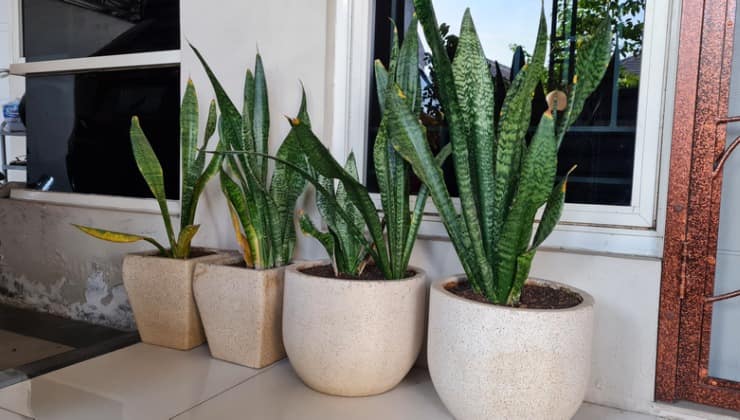
A good solution to solve this problem is to prepare a mixture of Marseille soap and water and clean the leaves by soaking a cotton pad.
With just one pass you will remove any parasites and the leaves will shine again because the dirt will also disappear. Do this once a week or every 15 days .
Don’t over water the plant
The yellowing of the leaves can also be due to excessive watering. This can happen when it’s warmer and you try to help the plant by putting more water, but it shouldn’t be done. if you notice that there is excess water, stop adding it for a few days and let the soil dry .
To avoid mistakes, water the plant when there is no more moisture in the soil , otherwise wait again. Also pay attention to the water that remains in the saucer, because if it stagnates the roots could get moldy and the plant could die.
Keep it out of the wind
It is essential to keep the mother-in-law’s tongue away from the wind, otherwise the leaves can turn yellow . Indeed, in this case the plant would suffer and the yellow leaves are the alarm that something is wrong.
The wind or drafts are poorly tolerated by this plant and if it is placed outside you must be careful to keep it inside when the air is blowing. Even sudden current inputs are not accepted by this plant which prefers to stay sheltered and safe .
Repot the mother-in-law’s tongue and fertilize it
To have a mother-in-law’s tongue with nice tall leaves it needs to have enough room to grow. We need to check that the roots can develop well and there is room in the pot to expand. It is important to understand if there is little space because this would cause suffering to the plant and cause the leaves to turn yellow.
If there is a need to repot it, do this in the spring , and in any case do it every two years, to give the mother-in-law’s tongue always the space it needs to develop. Plus, she also remembers to fertilize the plant, though many say succulents don’t need it.
It is not true at all and in the case of Sansevieria the yellowing of the leaves could derive from a lack of nourishment. Therefore, if you put the fertilizer, the plant will be able to have the nourishment necessary to keep the leaves green and beautiful.
The ideal fertilizer is a mixture based on potassium, phosphorus and nitrogen . Natural fertilizers are also excellent and among the best you can use those based on coffee grounds, containing all the nutrients necessary for mother-in-law’s tongue to grow luxuriantly!


